
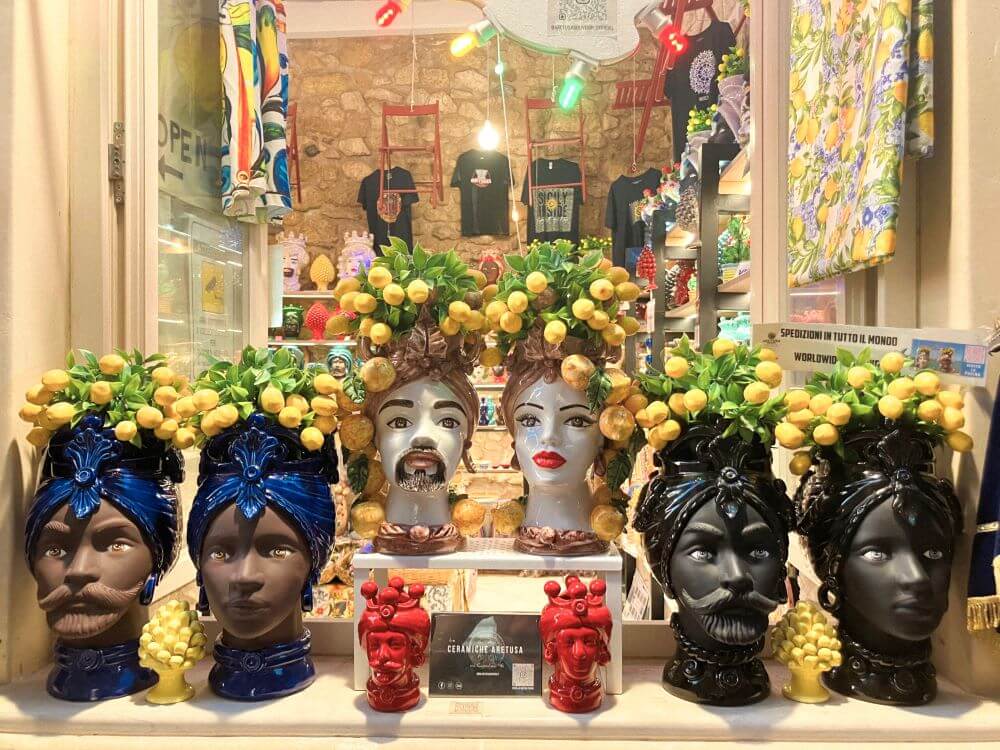
If you play a game of I Spy in Palermo, I bet you’ll find this one particular object on every street corner: a Sicilian head planter. The Moors head, also known as Graste, is a representative of Sicily and one of the most popular souvenirs to leave the island with.
Moors head planters are a pair of ceramic vases shaped into the facial likeness of a man and woman. Normally, these Sicilian head vases house plants, but you can also find them in miniature form as salt and pepper shakers or shelf decor.
While exploring the organic wineries in the middle of the island, I saw so many of these vases that I began to think there had to be a story behind them.
When you see something enough times, you begin to wonder about its significance. What does the Sicilian head planter mean, and how did it become such a ubiquitous symbol of the island?

Behold: The Sicilian Head Planter
Plant moms and dads sure do love a beautiful planter. Sicilians have lovingly housed their plants in ornate, decorative vessels for quite a long time.
The Sicilian head vases are usually in the likeness of a man or woman’s facial features: a rounded face with high cheekbones and juicy, plump lips. The faces are cupped in a bouquet of flowers and citrus fruits. Out of the top of the cranium shoot the flowers and herbs of the owner’s choice. The eyes sculpted into the clay look out with a soft gaze and express a secretive undertone.
The ceramic pots usually come in pairs: a man and a woman, seemingly lovers but without a glimpse of adoration in their eyes. Though the heads sit side-by-side, the painted faces stare straight ahead as if to ignore one another.
If the lips could speak, they may tell you a story more grisly than that of Romeo and Juliet in mainland Italy. This story is one of love, jealousy, betrayal, and murder, ultimately the origin of how these figures became an ever-present symbol of Sicily. Though true to the Sicilian way, those lips may divulge no secrets at all.

The Dark Story of the Moorish Heads
Like all pivotal stories, it starts with a boy and a girl in love. During the Moors’ occupation of the island, a beautiful woman named Kalsa lived in the Arab quarter of Palermo. A Moorish man passing through the city saw Kalsa and immediately fell in love with her. When he expressed his desire, the two fell madly in love and were quick to share a life together.
However, the man planned to leave Sicily, as it was never his intention to root himself on the island. Learning of this, Kalsa found that he was not only planning to leave Sicily but was planning to return to his home country where his wife and children were awaiting his arrival.
The betrayal sent her into a murderous rage. One night, while he slept, she murdered him and cut his head off with a knife. Kalsa left the Moorish head out on her balcony, where she grew a basil plant and watered it with tears.
The plant was robust and vibrantly green, leading neighbors to believe it was the vessel that made such a fine plant. Shortly after, they ordered ceramic vases in the Moor’s head likeness, beginning the tradition of the Sicilian head planters.
The Moorish History of Sicily
The term Moorish is a European-derived term that relates to merchants from Northern Africa. Sicily was the connection for trade across the Mediterranean and was often the docking point for those who traversed the waters.

The Lesson Behind Sicilian Head Vases
So, what can we learn from the legend behind the head vases… Besides not to double-cross a Sicilian woman?
You might interpret this story as a representation of Sicily. The island welcomes visitors and loves them through a bounty of agriculture and wine, but experiences betrayal when it’s not cared for in return. Being a major trade route, Sicily has seen its fair share of suitors come and go.
Occupiers of all descents, from the Greeks and the Phoenicians to the Moors and Arabs. A change of hands, a new group to take temporary responsibility for her land. Sicily welcomes its new occupiers with earthly goods but never earns a love that’s reciprocated or that lasts.
The story of the Moorish heads is poignant, with themes of love and betrayal. Sometimes, when we play with the fires of love, we walk away with a burn or a lost head! But if we’re lucky, we may earn ourselves a hearth to warm ourselves by. Such is the gamble of life!


