
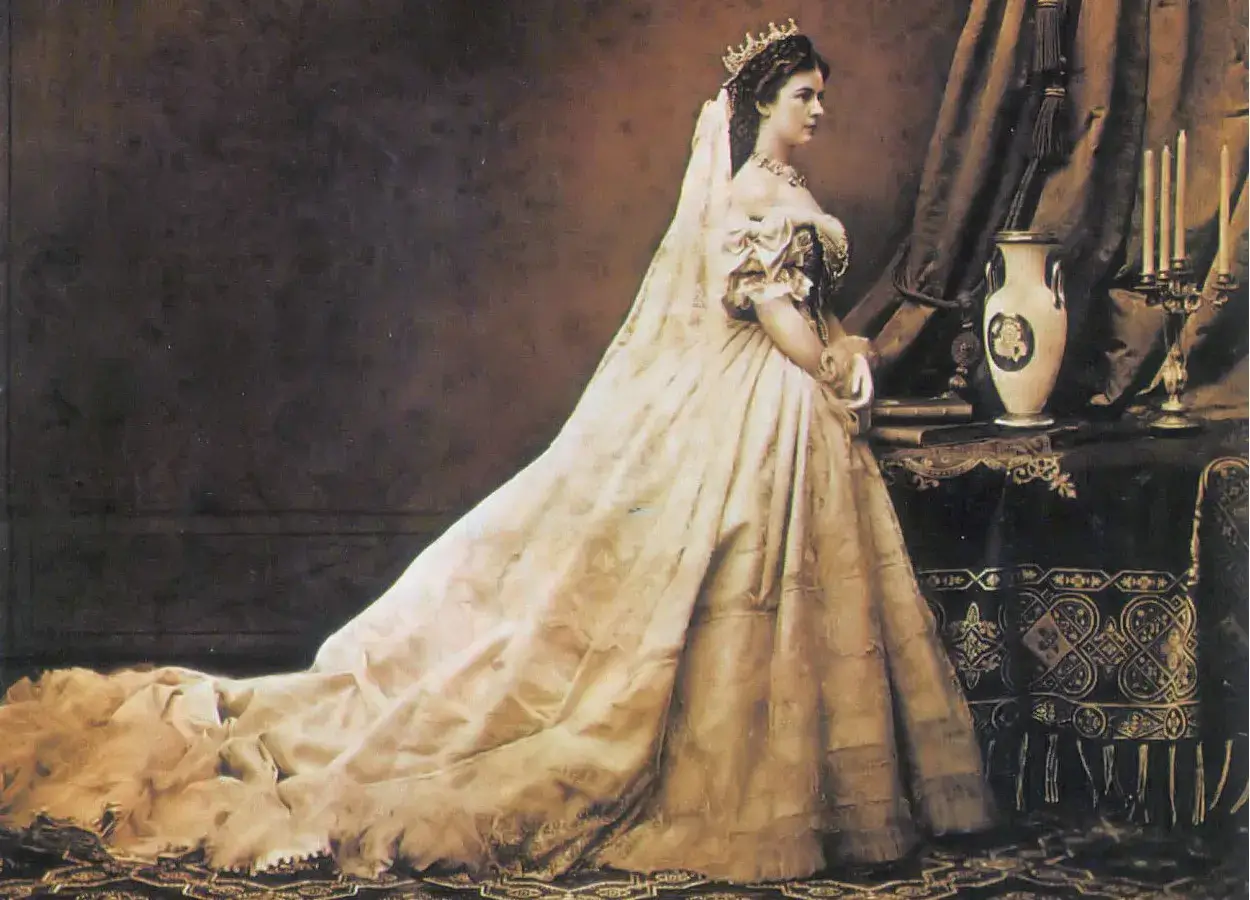
At first glance, Empress Elisabeth of Austria (known to her friends and the rest of history as Sisi) might seem like the epitome of a fairytale princess. Born into Austrian royalty in 1837, Empress Sisi spent a life surrounded by sumptuous palaces and fine clothes, but it was also full of sorrow and rebellion.
What I find most interesting about Empress Sisi is how polarizing she is, even in modern times. Some regard her as a feminist icon, whereas others note that she wasn’t exactly perfect in terms of motherhood and familial responsibilities.
Like so many women in history, if you scratch the surface of her story, you’ll find deeper complexity beyond Waltz dancing in ballrooms and opulent living.
So, let’s take a deep dive into the fascinating, frustrating, and frankly ahead-of-her-time world of Empress Sisi, the royal rebel.

The Royals Are Complicated
Imagine marrying into one of the most rigid royal courts in Europe. Born to the Bavarian House of Wittelsbach, Empress Sisi grew up in a somewhat informal youth in Bavaria (southern Germany). She and her siblings grew up in the countryside, where they often abandoned lessons to go horseback riding. Then at 16, in the middle of her adolescent years, she was married off to her first cousin, Emperor Franz Joseph I.
Her marriage to Franz Joseph yanked her out of a relatively low-key life and thrust her into the Habsburg Empire. At this time, the Habsburgs were powerful, had multiple palaces in Vienna as well as in the world, and were treated much like celebrities in Austria.
This was a hard reality to contend with. She was, apparently, someone who preferred to stay out of the public eye. She also liked her freedoms. Despite her beauty (which was legendary, as we’ll get to later), she wasn’t keen on the beauty standards or expectations that were expected of royal women at the time.
She Had a Troubled Relationship with Her Mother-in-Law
Archduchess Sophie, her mother-in-law (and also her aunt), had a peculiar dislike toward Sisi, whom she considered unruly. To give an example, she often called Empress Sisi a “silly young mother” once she started having kids. That was at the tender age of 17.
Empress Sisi gave birth to her first child only ten months after her wedding. Not only did Archduchess Sophie name the baby after herself without consulting anyone, but she also demanded that the baby stay in her care. Empress Sisi was not allowed to breastfeed or look after her own child.
She Was Awakened by Travel and Stunted by Tragedy
Archduchess Sophie was the source of significant tension, which brought an onslaught of health issues believed to be psychosomatic. Empress Sisi experienced lung problems, was a poor sleeper, and hardly ate during her time in Austria.
When Empress Sisi traveled outside the court, things began to change. The first time she visited Hungary, Empress Sisi was touched by the people she met there. She even began learning Hungarian. In turn, Hungarians proclaimed their love for the Austrian Empress. Patrick Leigh Fermor wrote from a trip to Hungary that Empress Sisi’s picture was “framed on desks and tables and grand pianos.”
However eye-opening this travel adventure was for Empress Sisi, her trip to Hungary also came with tragedy. During this time, her two daughters became ill with what was likely typhoid. Her first daughter, Sophie (the one named after Archduchess Sophie) succumbed to her illness at age two.
Although this was not the last tragedy to happen in Sisi’s life, it was the marking of a shift for her. She was known to fall into days of melancholy, but the death of Sophie launched this into bouts of full-fledged depression. Empress Sisi was suffering from stress-related health problems, and now from a broken heart. It was during this time that she became pregnant for a third time and began neglecting her second child, Gisela.
She Was an Advocate for Hungarians
Despite royal expectations of a woman’s place in politics, Empress Sisi was embroiled in negotiations between Austria and Hungary, taking a liberal stance and advocating for the Hungarians.
Although she didn’t lead large public campaigns for human rights (she wasn’t exactly out there handing out pamphlets), she did demonstrate a progressive approach to freedom. She bargained for the freedom of Hungarian prisoners and played a major role in the Austro-Hungarian Compromise of 1867, leading to the Austria-Hungary dual monarchy.
She Spent More Time Out of the Palace
After the death of Sophie and the birth of her third child, Empress Sisi became increasingly rebellious against her husband and mother-in-law. She was an outsider in the way she held herself and became the center of court gossip.
Sisi retreated to various private residences, like the Schönbrunn Palace and, most notably, the Ischl Palace in Austria, where she could maintain some semblance of control over her life. After the Austro-Hungarian Compromise, she and Franz Joseph were given a country home in Hungary as their coronation gift. She would go on to spend nearly a full year and give birth to her fourth child there.
It was in these places where she exercised a level of freedom that was practically unheard of for a royal woman in the 19th century.
Her husband, Franz Joseph I of Austria, often spent time without Sisi. Their relationship consisted of long periods without the Empress, as she often traveled without him. Though that didn’t seem to make a dent in his feelings for her. Following frequent goodbyes, he would write letters proclaiming that “there was no end in need” for her.
She Had a Troubled Relationship with Appearance
Empress Sisi’s rebellious nature manifested in other ways, most notably through her personal image. She was an early adopter of a physically demanding exercise regimen, which included horseback riding and fencing, defying the norms for women of her rank who were expected to maintain delicate, demure airs. She took long, fast-paced walks that sometimes lasted hours, and hardly ate.
She was so committed to her fitness routine that it became famous in its own right, but that’s where history doesn’t do Empress Sisi justice. Her tiny waist (reportedly only 16 inches) was the result of extreme tightlacing, the practice of wearing a progressively tighter corset.
At face value, it may seem that Empress Sisi was self-absorbed. Her modern critics often point to an excerpt she wrote stating, “Children are the curse of a woman, for when they come, they drive away beauty, which is the best gift of the gods.”
I think there is something else to consider. She was a woman who was not fit for royal life, nor did she want to be. Yet, she was restricted by this life that she had been married into, without choice, at the age of 16. Her physical appearance may have been the one thing she had complete autonomy over.
Mentioning beauty, Empress Sisi was often called one of the most beautiful women in Europe. Even a trip to Austria now will showcase those legendary looks stamped on every chocolate tin and shot glass you’ll find in Vienna.

Not Your Typical Royal Mother, Not Your Typical Motherhood
At this time in the Viennese court, the most important objective of an empress was to give birth to a male heir, which she did when Crown Prince Rudolf was born. Empress Sisi gave birth to three other children, but her relationship with each of them was strained.
According to Habsburger.net, Empress Sisi was constantly at odds with the obligations of motherhood (and royal life) versus what she truly wanted, which was to be independent.
Her familial relationships reached a point of obscurity after the tragic death of her only son in 1889. His death was part of a joint suicide planned with 17-year-old Baroness Marie von Vetsera, a girl with whom he was having an extramarital affair. This profoundly affected Sisi, pushing her further into emotional isolation. She wore black and gray, symbols of mourning, for the rest of her life.
Her despair further distanced her from her family and the court. She traveled solo more frequently and for longer periods of time. This led to her own tragic end when, in 1898, while traveling in Switzerland, Empress Sisi was assassinated by an Italian anarchist.
After receiving the message of his wife’s death, Franz Joseph I exclaimed, “You have no idea how much I loved this woman.”

Empress Sisi and Her Legacy As We Know It
Today, Sisi’s life has become the stuff of Austrian lore, immortalized in film and literature, particularly in the 1950s “Sisi” movie trilogy starring Romy Schneider. Most recently, she was the inspiration and true story behind the 2022 Netflix series “The Empress.”
Her story speaks to anyone who has ever felt confined by societal expectations, anyone who has chafed at the idea of having to fit into someone else’s vision of who they should be.
In Hungary, Austria, and beyond, she remains a feminist icon for the way she rejected the passive roles assigned to her as a royal woman.


