
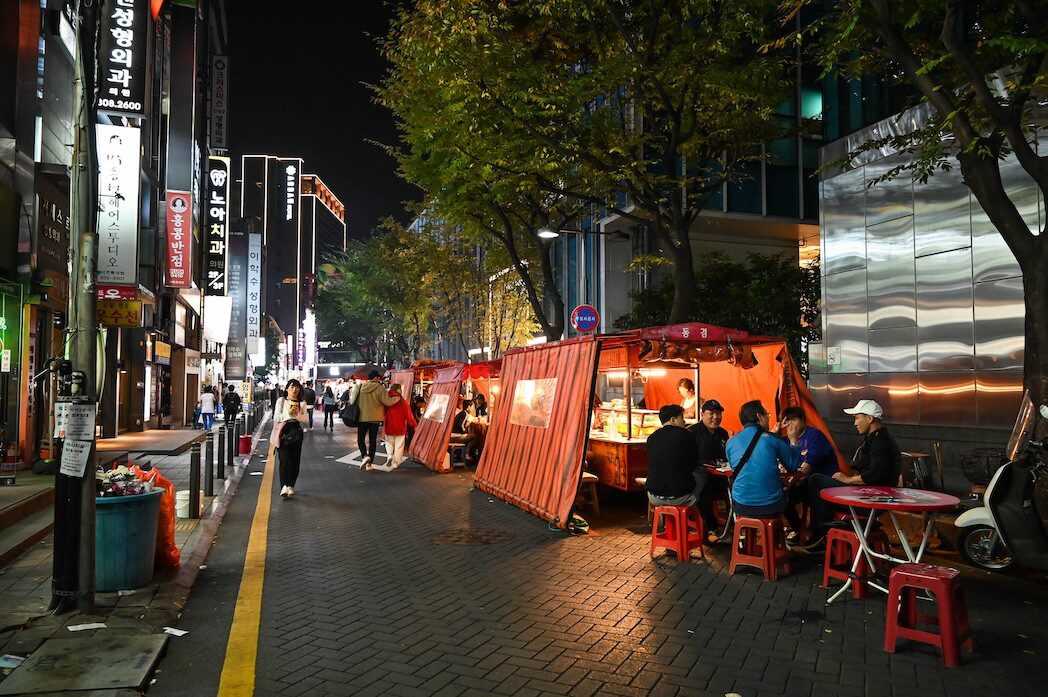
K-pop or K-drama lovers are already familiar with those funky, little red tents that crop up all over the streets in South Korea. Pocha is a shortened Korean term for pojang-macha, a streetside cart that serves drinks and food for cheap. These little businesses might be a moveable cart or a tent set up with plastic chairs and a transportable grill. They happen to be one of the most iconic experiences in South Korea.
Sharing a beer with friends inside a pocha was one of my favorite pastimes when I lived in South Korea. Although I had originally moved there to become an English teacher, I was deeply fascinated by Korean culture and launched my career as a travel journalist by sharing my stories as an expat. Tasting Korean street food and mingling with locals at these stalls was exactly the introduction I needed to explore culture and heritage further.
So how can you explore South Korean street food? By checking out a pocha on your next trip to Seoul, of course! Here’s everything you need to know about pochas, including what to order and where to find them. pochas?
What Is a Pocha?
A pocha is a tiny, portable stall or tent serving food and drinks in South Korea. The literal translation of pocha is covered wagon. All year long, these vendors serve up street food and bar snacks for snack-ish patrons. You’ll recognize a pocha because they usually have a bright red tent and almost always a steaming grill set up on the side of the street.
This is not quite a restaurant and not exactly official. You likely won’t find a food safety rating pinned to the front or a food inspector anywhere in the vicinity but fear not. Similar to the legendary street food in Thailand, South Korea also has a culinary prowess that precedes its reputation.

South Korean Comfort Food
If there were a place to gain an exorbitant amount of weight, Korea would be the destination. Food is spelled with a capital “F” here and by a variety of options. Endless choices line up and down street corners, flashing signs, and pictured menus scale the sides of buildings where restaurant workers step in your path as a means to lure you in. Although Seoul has a world-class restaurant scene, comfort food is where you’ll find true enjoyment.
The streets are perfumed with the savory smells of grilling meat or bowls of piping hot noodles. Turn the corner, and you find vendors roasting chestnuts or flattening pancakes that ooze nuts and honey from the filling.
A myriad of restaurants exist inside Seoul and belong to all different categories. In front of the traditional restaurants, old men sit outside to drink chilled soju and play card games. Then there are the new age spots: artisanal coffee and croiffles (croissant waffles), craft beer, and bulgogi pizza.
There are places where you can have a healthy dinner of seasonal Korean vegetables and seafood, all served by a hanbok-clad waitstaff, and hole-in-the-wall joints that serve squid tentacles in a spicy sauce, served with a soju.
Pojang macha: Unofficial Drinking Spots
But of all the places to eat in Seoul, my favorite is not an establishment you can find with Michelin-star merits or a fusion-style menu. Although they exist year-round, visiting a pocha is especially pleasant during the winter.
During the colder months, vendors wrap their businesses inside large red tents. You can walk inside, with plenty of room to stand, sit, and spread out at one of the plastic tables. The ceiling is wrapped with hanging lights, all connected by orange extension cords. The heaters at each corner are perfectly warming, plus the grill in the middle feels more like an incubator than a cooking tool.
When walking in from the bitter, dry cold of Seoul, it feels like entering into an oasis within a city made of ice. The best places to experience pocha in Seoul are the intersections near Jongno 3(sam)-ga and Euljiro 3(sam)-ga.
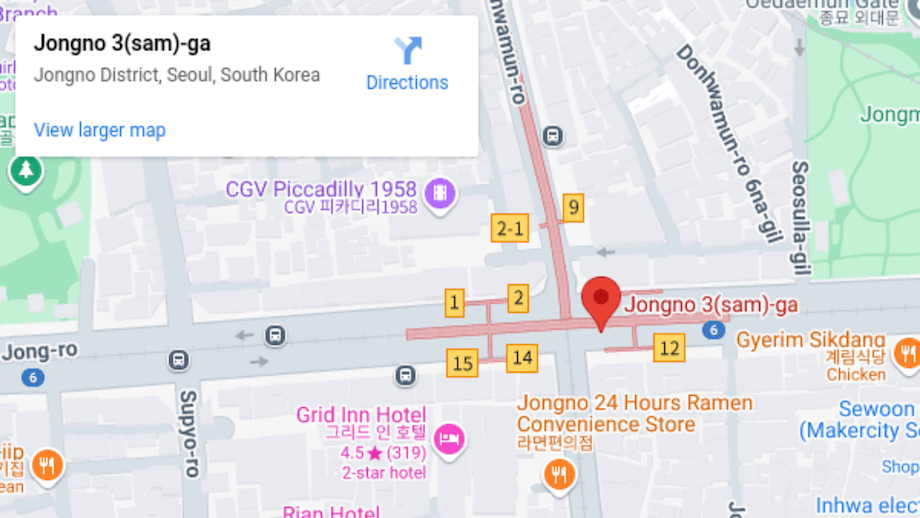 Map of Jongno, Seoul, South Korea[
Drinking at a Pocha as a Traveler
I won’t deny that a few questioning looks made their way across the pocha to our corner. It’s true that in some less touristy neighborhoods, expats often don’t venture and the ones who do end up sticking out like sore thumbs.
On occasion, some people from the other tables looked over at us before continuing their conversation in a hushed tone. While there are plenty of foreigners in Seoul, times like this remind me of my foreignness.
However, it’s usually not out of ill will. It can be a bit surprising to see an expat trying to appreciate the parts of Korean culture that don’t often appear in commercial travel. My friend and I ignored it and continued our drinking, eating, and conversation, ultimately enjoying ourselves. As time passed and the people relaxed around us, I began to hear other tables use English words in their conversations.
Read more: Honbap: A Friend of Mukbang Born From Loneliness
Korean Pochas in the USA
While pochas are well-known and easy to find all throughout Korea, it’s a different story in other countries. In a place that is highly regulated, like the United States, a street food vendor needs to pass inspection and follow the same food safety procedures as any brick-and-mortar restaurant. What you get instead are restaurants that give the “vibe” of a Korean street cart.
In New York City, Pocha 32 has earned a few mixed reviews, ranging from people who love the spot and those who think it’s just average. The restaurant bumps loud music and has dim lights, which makes it feel more like a club than a low-key snack tent. Los Angeles, with a much bigger Koreatown and technically closer to mainland South Korea, has quite a few more options.
First, there’s Joopocha Gastropub, which pairs an authentic tent-style experience with karaoke. Hanshin Pocha has patio seating outside for a slightly more upscale experience. Lastly, Go Pocha has the best low key atmosphere and is closer to the “true” pocha experience, in my opinion.
Tips for Visiting a Pocha in Seoul
Seoul is by far the most tourist-friendly city in South Korea. That isn’t to say you won’t be welcomed in other parts of the country (personally, I think your reception in a country has more to do with being a good traveler), but finding English speakers can be few and far between. The same thing goes in a pocha.
Pochas are not typically a place where tourists go unless they can speak Korean or are accompanied by someone who does. It may be best to brush up on your language skills or download an essential travel app for easy translations.
Most pochas accept either cash or bank transfer, but few of them will accept a credit card and all the transaction fees that go with them. You’ll find ATMs in most of the subway stations and usually have an English language option to choose from.
Otherwise, pochas are typically laidback and very casual. Don’t worry about putting your best Korean etiquette together for the event. Use the normal honorifics if you’re speaking to someone older than you and, if you just so happen to be the youngest person at the table, be prepared to pour everyone’s drink before your own!
Night Turns into Morning
My friend and I initially took our seats at the round pocha table around eight at night. What would have been an hour or two quickly turned into stumbling home at one in the morning. We stuffed our faces, drank seven bottles of soju, laughed, and talked all night, all for less than $80. By the time we were ready to leave, the inside of the pocha was mobbed with people, and our coats were made warm from the grill.
We stepped out of the tent and back into the January air. The volume had increased inside the tent, and we listened to boisterous laughter as we made our way down the street. We were even a bit surprised with how quickly the time had passed. We lamented about the weekend being over so quickly. The experience is common in sleepless Seoul, the city that offers an activity for every hour of the day. You realize how fast the time slips by when you’re busy chatting with friends under a red tent.


